DCP111 – Wayne Farris – Honky Tonk Man –
Price range: $22.00 through $40.00
Wayne Farris — Before He Was The Honky Tonk Man.
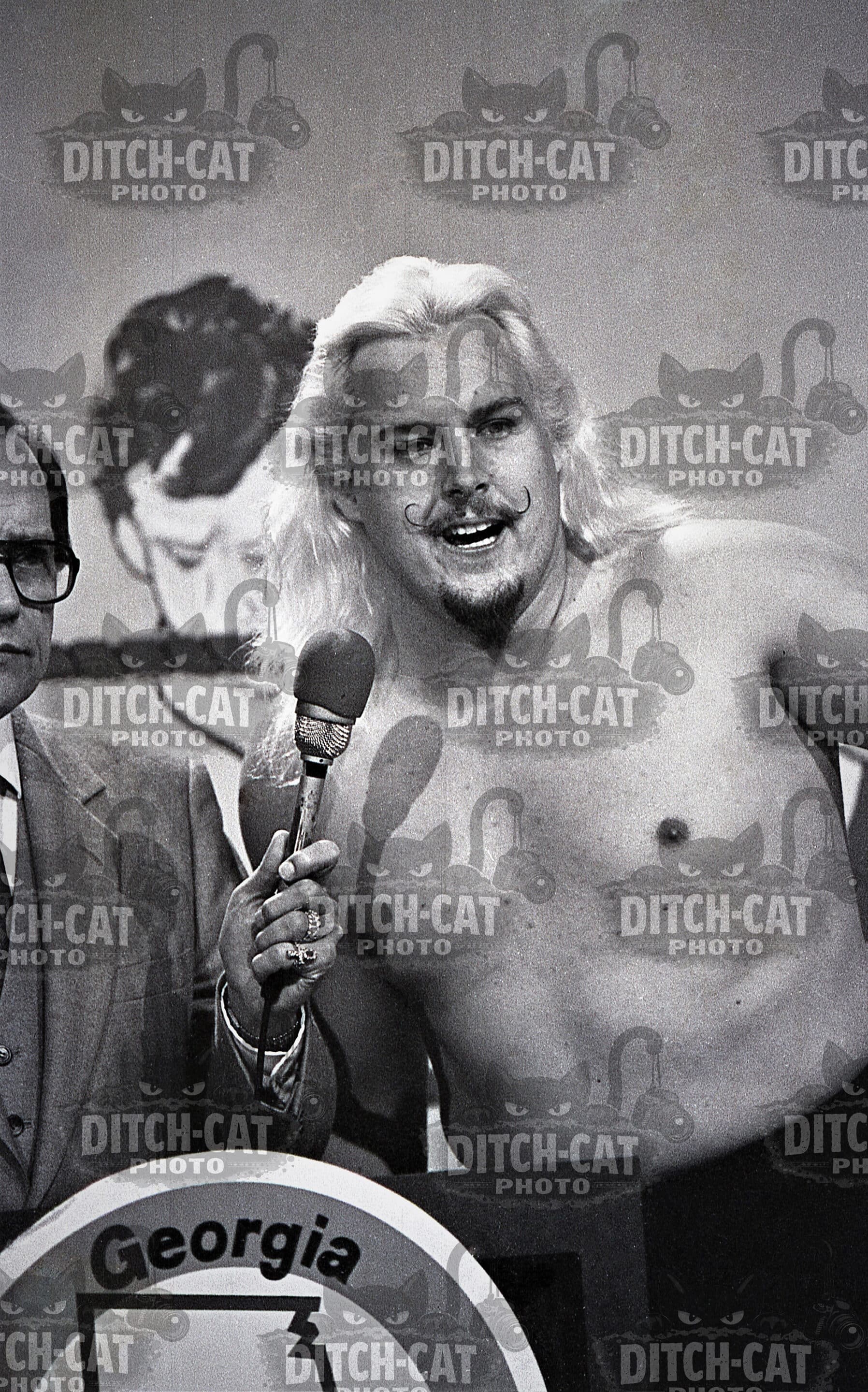
The future WWE Hall of Famer captured on the Georgia Championship Wrestling desk during his territory days on WTBS. Original Ditch-Cat Photo print, available in multiple sizes, postage paid.
Every print includes standard shipping — no surprise fees at checkout.
Orders are fulfilled and shipped within 10 business days of payment confirmation.
All photographs are printed directly from the original negative or positive — not digital scans, not reproductions. You’re getting the real thing.
All images are fully copyrighted and protected against unauthorized reproduction or infringement.
Many of these prints are available for a limited time only. Once they’re gone, they’re gone for good. If a shot speaks to you, don’t wait.
All sizes are approximate.
All prints ship postage paid.
10-day turnaround.
Wayne Farris
Before He Was The Honky Tonk Man — Georgia Championship Wrestling on WTBS
The Bio
Wayne Farris — born Roy Wayne Farris on January 25, 1953, in Bolivar, Tennessee — is the WWE Hall of Fame inductee the world would eventually come to know as The Honky Tonk Man. But long before the sequined Elvis jumpsuits, the acoustic-guitar chair shots, and the record-breaking Intercontinental Championship reign, Farris was just Wayne — a University of Memphis graduate and former high school football coach who broke into professional wrestling in 1977 under trainer Herb Welch. He was, and remains, the cousin of Jerry "The King" Lawler, and the two grew up in the same Memphis wrestling ecosystem that produced some of the sport's most enduring stars.
Farris earned his stripes across the Southern territories under a rotating cast of names and masks — Wayne Farris in Memphis, Dynamite Wayne Farris in Birmingham's Southeastern Championship Wrestling, and briefly as The Medic, The Red Shadow, The Black Demon, El Diablo, The Masked Marvel, and The Kisser wherever the booking called for it. His first real breakout came as one half of The Blond Bombers with Larry Latham, a heel tag team that tore through the Nick Gulas and Jerry Jarrett Tennessee territories and gave the wrestling business one of its most infamous moments — the Tupelo Concession Stand Brawl against Jerry Lawler and Bill Dundee, a piece of wrestling folklore still talked about today.
Farris spent time in Georgia Championship Wrestling in the early 1980s — captured here on the WTBS studio desk — where he captured the NWA Georgia Television Championship. He then moved on to Stampede Wrestling in Calgary in 1982, where booker Bruce Hart handed him a new gimmick: "Honky Tonk Wayne," a full-on Elvis impersonator. Farris won the Stampede North American Heavyweight Championship and three Stampede International Tag Team Championships during his run, feuding with the legendary British Bulldogs and Bad News Allen along the way.
In 1986, Farris joined the World Wrestling Federation as The Honky Tonk Man — refining the Elvis-inspired heel character that would define his career. On June 2, 1987, he captured the WWF Intercontinental Championship from Ricky "The Dragon" Steamboat, and held it for a record 454 consecutive days — the longest single reign in the championship's history, a mark that has never been broken. He lost the title in 30 seconds at the first-ever SummerSlam pay-per-view in August 1988 to The Ultimate Warrior, in what remains one of the most iconic moments in WWF programming. Farris continued with the company through 1991, had a brief WCW run in 1994, and worked the independent circuit for decades before formally retiring in 2019. That same year, he was inducted into the WWE Hall of Fame.
This photograph — captured by Ditch-Cat Photo at the WTBS Studios during the taping of Georgia Championship Wrestling — preserves a rare moment: Wayne Farris on the interview desk of one of professional wrestling's most historic broadcasts, years before the world knew what a Honky Tonk Man was.
The Evolution of a Character: Wayne Farris → Honky Tonk Wayne → The Honky Tonk Man
The character now enshrined in the WWE Hall of Fame was not built in a single moment — it was assembled piece by piece across a decade of territory work, in dressing rooms from Memphis to Birmingham to Atlanta to Calgary.
Wayne Farris (1977–1982) — Farris debuted as a straight-ahead Tennessee heel with a country-boy edge, working the Nick Gulas and Jerry Jarrett territories under his own name and rotating through masked and mystery-man gimmicks (The Medic, The Red Shadow, The Black Demon, El Diablo, The Masked Marvel, The Kisser) whenever the booking called for one. His breakthrough came in 1979 as one half of The Blond Bombers with Larry Latham, a Memphis heel team that produced the infamous Tupelo Concession Stand Brawl against Jerry Lawler and Bill Dundee — one of the most-talked-about matches in wrestling history. Farris also worked Georgia Championship Wrestling during this period as pictured in this print, and captured the NWA Georgia Television Championship during his time on WTBS.
Honky Tonk Wayne (1982–1986) — In 1982, Farris signed with Stu Hart's Stampede Wrestling in Calgary, where booker Bruce Hart handed him the seed of the gimmick that would define him: an Elvis Presley impersonator character named "Honky Tonk Wayne." Farris embraced it, working the Stampede circuit in full Elvis regalia, capturing the Stampede North American Heavyweight Championship and three Stampede International Tag Team Championships, and honing the character's signature swagger against opponents like Bad News Allen and the British Bulldogs. This is where the sneer, the strut, and the guitar were born.
The Honky Tonk Man (1986–1991, WWE) — When the WWF acquired talent contracts from Stampede in 1986, Farris made the jump to New York, refined the gimmick, and became The Honky Tonk Man — managed by Jimmy Hart, walking to the ring to his own theme song "I'm a Honky Tonk Man," and finishing opponents with the Shake, Rattle & Roll neckbreaker. On June 2, 1987, he defeated Ricky "The Dragon" Steamboat for the WWF Intercontinental Championship and held it for 454 consecutive days — a record that still stands today, more than 35 years later. He lost the title to The Ultimate Warrior in a 30-second squash at the very first SummerSlam on August 29, 1988, in a moment that has been replayed, referenced, and parodied countless times in the decades since.
The photograph in this print captures the middle chapter — Farris after the Blond Bombers, before the Elvis suit, standing on the very interview desk where a young wrestler's promo could carry across the entire country on Ted Turner's satellite signal. The full character was still years away. But the charisma that would carry him into the Hall of Fame was already there for anyone who was watching.
About Georgia Championship Wrestling on WTBS
Georgia Championship Wrestling debuted in 1972 on Ted Turner's then-modest Atlanta independent station WTCG-Channel 17, under the booking of promoter Jim Barnett. On December 17, 1976, WTCG became one of the first stations in the United States to be uplinked to a satellite, transforming Turner's local Atlanta station into a "Superstation" beamed into homes nationwide. From that moment, Georgia Championship Wrestling on WTBS — broadcasting from Studio One on Techwood Drive and anchored by the unmatched voice of Gordon Solie — became the first wrestling program to reach a national cable audience, decades before any of its rivals could claim the same milestone. The show launched the careers of Tommy "Wildfire" Rich, Buzz Sawyer, Magnum T.A., and a generation of stars, and made Solie's call synonymous with wrestling television itself. On July 14, 1984 — the day remembered in wrestling history as "Black Saturday" — Vince McMahon Jr. acquired the program's Saturday 6:05 PM time slot and replaced it with WWF programming, an act that helped accelerate the collapse of the territory system. The broadcast was rebranded as World Championship Wrestling in 1985 and ran until WCW itself was sold to the WWF in 2001
Additional information
| Size | 11 x 14, 8 x 12 |
|---|
Related products
-
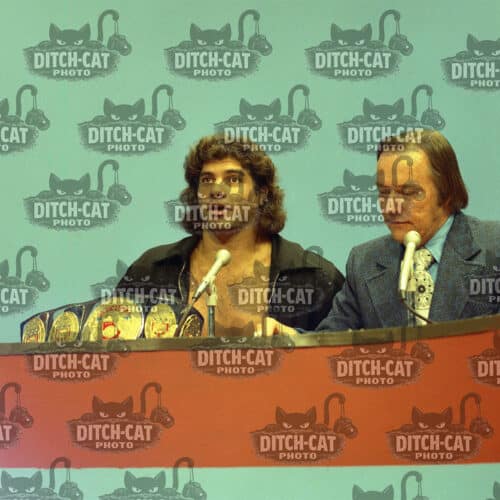
DCP120 – Don Muraco and Gordon Solie TBS Studios
Price range: $40.00 through $45.00 -
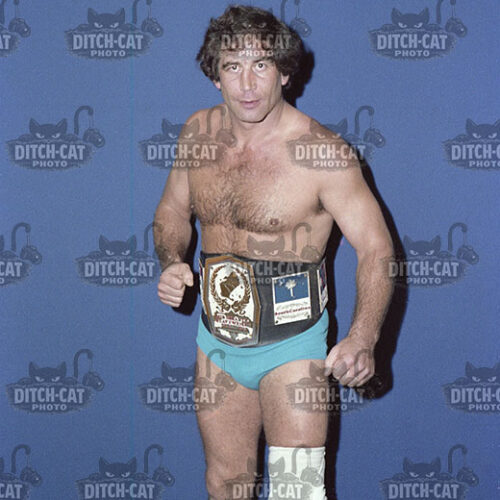
DCP106 – Jack Brisco
Price range: $22.00 through $65.00 -
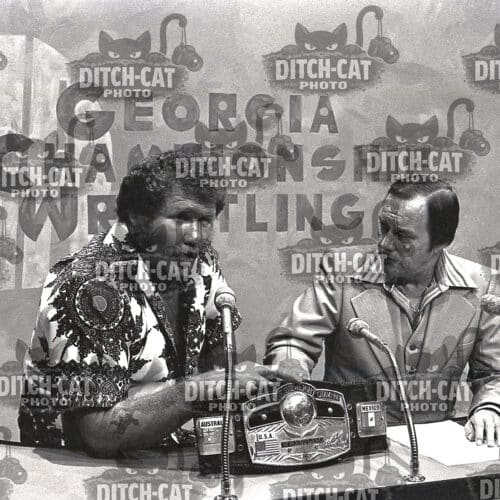
DCP115 Harley Race and Gordon Solie TBS Studios
Price range: $40.00 through $65.00 -
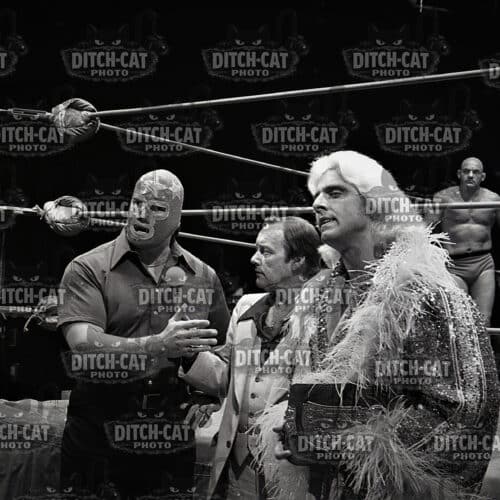
DCP117 Ric Flair, The Masked Superstar and Gordon Solie – TBS Studios
Price range: $40.00 through $45.00 -
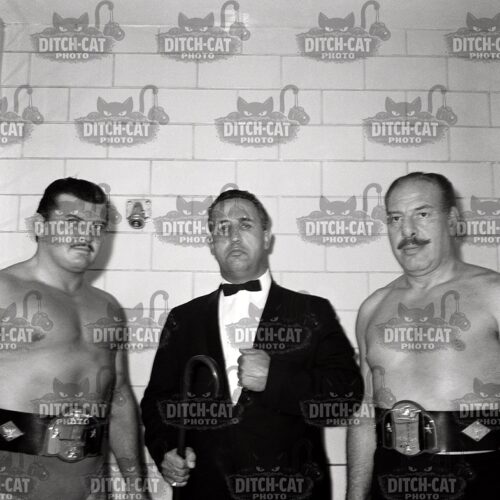
DCP103 – Bronco Lubich – Homer O’Dell – Aldo Bogni
Price range: $22.00 through $40.00
Reviews
There are no reviews yet.